
Can You Tent Just One Townhouse for Termites? The Shared-Wall Problem
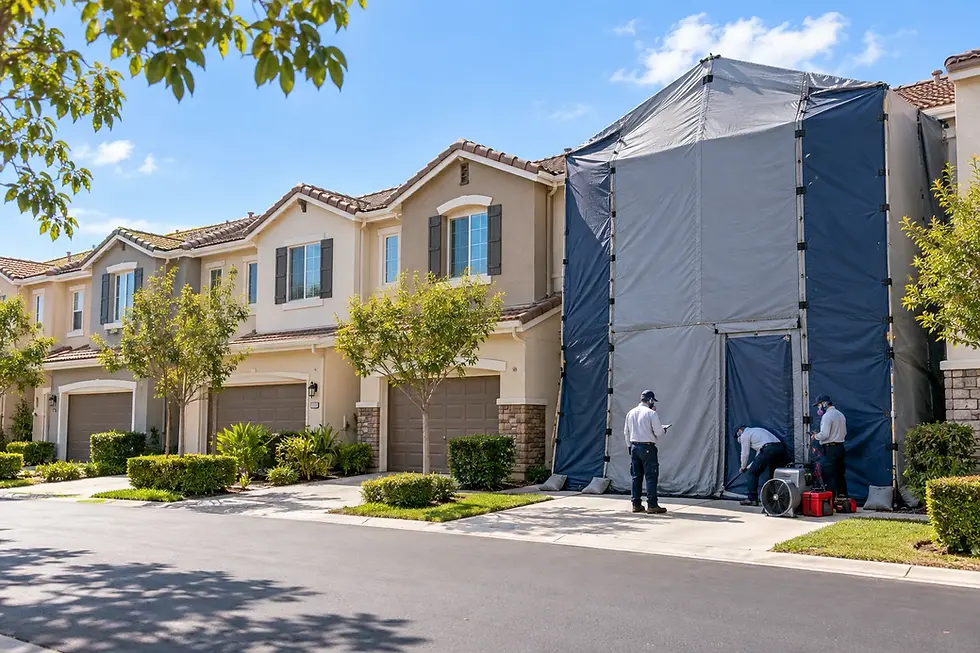
The inspector says you need a tent. Which would be straightforward if you lived in a standalone house — but you don’t. You share walls. Your unit is one of four, or six, or eight connected townhomes, and now you’re realizing the problem isn’t just your termites. It’s that fumigation might require your neighbors to agree, pack up, and clear out for a couple of days too. And at least one of them is already giving you a look that says ‘absolutely not.’ The specific question is: can I just tent my own unit, or does this whole building have to do it together? It’s a genuinely stressful situation, and the answer has real consequences for your timeline, your budget, and your relationship with the people next door.
Here’s the honest reality about the can you tent one townhouse for termites question. For whole-structure fumigation, you generally CANNOT tent a single attached unit in isolation — the gas has to fill a sealed structure, and attached units share wall cavities, attics, and airflow that make true isolation impossible. If fumigation is the right treatment for a widespread drywood infestation, the entire connected structure typically has to be sealed and treated as one unit. That’s exactly why the ‘one neighbor won’t agree’ scenario turns into such a nightmare — and why, in real cases, homeowners have described feeling held hostage while termites keep eating their walls.
But — and this is the part that changes everything — fumigation is not always the only option. Let’s walk through the can you tent one townhouse for termites question in full, what happens when a neighbor refuses, the no-tent alternatives that can treat your unit without a building-wide standoff, and how HOA and legal routes fit in.
Quick Answer
Can you tent one townhouse for termites? Not for whole-structure fumigation — attached units share wall cavities, attics, and airflow, so the gas can’t be contained to one unit.
So the whole building has to tent? For fumigation, yes — the entire connected structure is sealed and treated as one. That’s why one holdout neighbor can block it.
What if a neighbor won’t agree? You have options — no-tent localized treatment for your unit, HOA authority (if applicable), and in some cases legal routes.
Is there any way to treat just my unit? Yes — localized/no-tent Drywood treatments (foam, spot, orange oil) can target your unit without tenting the building.
Best first step? A FLIR inspection to confirm whether you even need fumigation. Call Termike at (888) 683-3592. |
Why You Can Trust Termike Pest Control
License: California Structural Pest Control Board — License PR8832 (Branch 2 & 3 certified)
Membership: National Pest Management Association (NPMA)
Experience: 25+ years serving Orange County, LA County, Riverside & San Bernardino County
No-Tent Options That Sidestep the Standoff: We offer localized and no-tent Drywood treatments that can address your unit without needing every neighbor to agree to a full-structure tent
Honest About What Fumigation Requires: If whole-structure fumigation truly is the only option for a widespread infestation, we tell you plainly — including the coordination it takes across attached units |
Why You Can’t Tent One Townhouse for Termites in Isolation
To understand the whole problem, you have to understand how fumigation actually works. Whole-structure fumigation (tenting) seals the entire building under a gas-tight tarp and fills it with a fumigant — sulfuryl fluoride (Vikane) in most California Drywood cases — that penetrates every piece of wood in the sealed space. The treatment depends on the gas reaching a lethal concentration everywhere inside and staying there for the required exposure period.
Shared Structure Means Shared Gas Space
Here’s why can you tent one townhouse for termites gets a hard ‘no’ for fumigation specifically. Attached townhomes don’t have truly separated envelopes. They share wall cavities, often share attic and roof spaces, and have connected framing and airflow paths. You can’t seal a gas-tight barrier down the middle of a shared wall — the fumigant would leak between units, meaning you can’t achieve or maintain the lethal concentration in your unit alone, and you’d be pushing gas into neighbors’ occupied space. For the treatment to work and to be safe, the whole connected structure has to be sealed and vacated together.
This Is Specific to Fumigation
It’s worth being precise: this all-or-nothing rule applies to whole-structure fumigation, not to every termite treatment. Localized treatments don’t require sealing the building. That distinction is the key that unlocks most shared-wall standoffs — and the next sections cover it. Termike’s guide on whether you really need to tent your house walks through when fumigation is genuinely necessary versus when it’s not.
According to the University of California Integrated Pest Management Program, drywood termites can be managed with several approaches including whole-structure fumigation AND localized treatments — meaning fumigation is one tool, not the only one, which matters enormously when a neighbor is blocking the tent.
What Happens When a Neighbor Won’t Agree to Tent
The can you tent one townhouse for termites question stops being academic the moment a neighbor says no — and it’s a real scenario that plays out constantly in attached housing. One owner refuses to participate — maybe they don’t believe they have termites, maybe they can’t afford their share, maybe they just don’t want the hassle of vacating. And because fumigation is all-or-nothing for the connected structure, their refusal can stall everyone.
• The infestation keeps spreading. While the standoff drags on, Drywood termites keep feeding. The delay has a real cost in accumulating damage
• Spot treatments may not be enough for widespread activity. If the Drywood infestation is truly widespread across the structure, localized treatment of just your unit may leave activity in shared framing
• The holdout may have legitimate concerns. Sometimes the refusing neighbor genuinely doesn’t have activity in their unit, or has cost or health concerns worth addressing rather than steamrolling
• Offering to pay their share sometimes works. In some real cases, affected owners have offered to cover the holdout’s cost or relocation to break the deadlock — sometimes successfully, sometimes not
The practical takeaway: a neighbor refusing to tent doesn’t automatically mean you’re stuck doing nothing. It means fumigation specifically is blocked — which redirects you toward the no-tent options below, and potentially toward HOA authority if your community has it.
The No-Tent Options That Can Treat Your Unit Alone
This is the part that too often gets skipped in the panic. Even though the answer to can you tent one townhouse for termites is no, for many Drywood infestations — especially localized ones — there are legitimate treatments that target your unit without sealing the whole building. They sidestep the shared-wall standoff entirely.
• Localized foam and dust injection. Technicians drill into infested wood and inject termiticide foam or dust directly into the galleries, killing termites in that specific area without any tent
• Orange oil (d-limonene) spot treatment. A contact treatment injected into accessible Drywood colonies. See Termike’s guide on whether orange oil works for termites for its honest capabilities and limits
• Borate wood treatment. For accessible wood during any repair or renovation, borates protect wood going forward. Termike’s piece on Bora-Care borate treatment covers how it works
• Heat treatment of localized areas. Targeted heat can kill Drywood termites in a defined area without gas or tenting
The honest caveat: no-tent options work best for localized, identifiable Drywood activity. If inspection finds truly widespread infestation throughout the shared structure, these may not fully resolve it — which is exactly the scenario where fumigation’s whole-structure coverage is designed to succeed, and where the neighbor standoff becomes a genuine problem to solve. A proper inspection determines which situation you’re actually in. Termike’s no-tent termite treatment in Burbank page covers the localized-treatment side.
When HOA Authority and Legal Routes Come Into Play
If you’re in an HOA-governed attached community, the can you tent one townhouse for termites question may not be purely a neighbor negotiation — your association’s governing documents may give it authority to compel treatment.
• Check your CC&Rs. In many California attached planned developments, the HOA has responsibility for the shared structure and, where the CC&Rs grant it, authority to require termite treatment across units
• The structure-versus-unit split matters. Shared structural elements (exterior walls, roof, foundation) often fall under HOA responsibility, while the interior of individual units may not
• California has specific HOA termite rules. State law imposes specific notice and disclosure requirements when an HOA undertakes termite treatment. Termike’s deeper guide on California HOA termite treatment responsibility covers the statutory details
• Legal routes are a last resort. When an infestation threatens a shared structure and a holdout refuses, affected owners sometimes pursue remedies through the HOA or the courts — but this is slow, costly, and worth avoiding if a no-tent treatment can solve your unit’s problem directly
Because HOA authority and any legal remedy depend entirely on your specific governing documents and circumstances, this is general information rather than legal advice — your CC&Rs and an attorney or your HOA’s counsel are the authorities for your particular situation. The U.S. Environmental Protection Agency treatment framework is clear that matching the method to the scope of activity is the foundation — which, in shared housing, often means a no-tent option avoids the whole standoff.
The Bottom Line
The can you tent one townhouse for termites question has a clear answer for fumigation specifically: no, you can’t tent one attached unit in isolation, because shared wall cavities, attics, and airflow mean the gas can’t be contained or kept at a lethal concentration in a single unit — the whole connected structure has to be sealed and vacated together. That’s why one refusing neighbor can block a building-wide tent and leave everyone stuck while termites keep feeding. But fumigation is not the only treatment. For localized Drywood activity, no-tent options — foam and dust injection, orange oil, borates, targeted heat — can treat your unit directly without any building-wide standoff, and they’re often the cleanest way out of the shared-wall trap. If the infestation is genuinely widespread across the structure, HOA authority (where your CC&Rs grant it) and, as a last resort, legal routes come into play. The smartest first move isn’t to brace for a neighbor war — it’s to get a proper inspection that confirms whether you even need fumigation at all, because very often a no-tent treatment solves your unit’s problem without ever needing your neighbors to say yes.
Frequently Asked Questions
Can I tent just my own townhouse unit for termites?
Not for whole-structure fumigation. Attached townhomes share wall cavities, often share attic and roof spaces, and have connected framing and airflow — so a gas-tight barrier can't be sealed down the middle of a shared wall. The fumigant would leak between units, meaning you couldn't achieve or maintain the lethal concentration in your unit alone, and you'd be pushing gas into neighbors' occupied space. For fumigation to work and be safe, the entire connected structure has to be sealed and vacated together. The important exception is that fumigation isn't the only treatment — localized no-tent options (foam/dust injection, orange oil, targeted heat) CAN treat your individual unit without sealing the whole building, which is usually the way out when a neighbor won't participate in a building-wide tent.
What can I do if my neighbor refuses to tent for termites?
A refusing neighbor blocks fumigation specifically, but it doesn't mean you're stuck doing nothing. First, get an inspection to confirm whether you actually need whole-structure fumigation or whether localized no-tent treatment can resolve your unit's activity — very often it can. If the infestation is genuinely widespread through the shared structure and fumigation really is necessary, your options include: working with the holdout (some affected owners have offered to cover the neighbor's cost or relocation to break the deadlock), invoking HOA authority if your CC&Rs grant the association power to compel treatment of shared structure, and, as a slow and costly last resort, legal remedies through the HOA or courts. The practical path for most people is the no-tent route — treating your own unit directly so a single holdout can't hold your home hostage while termites keep feeding.
Does the whole HOA or building have to pay if one unit has termites?
It depends on your governing documents and where the termites are. In many California attached planned developments, shared structural elements — exterior walls, roof, foundation, shared framing — fall under HOA responsibility, while the interior of individual units may be the owner's responsibility. If the infestation is in shared structure, the association may be responsible for treatment and cost allocation under the CC&Rs; if it's confined to one unit's interior, it may be that owner's cost. California also imposes specific notice and disclosure requirements when an HOA undertakes termite treatment. Because this turns entirely on your specific CC&Rs and circumstances, review your governing documents and consult your HOA's counsel or an attorney for your particular situation — this is general information, not legal advice.
Is no-tent treatment as effective as fumigation for a townhouse?
It depends on the scope of the infestation. For localized, identifiable Drywood activity, no-tent treatments — foam and dust injection into galleries, orange oil spot treatment, targeted heat — can be very effective at eliminating termites in the treated area, and they have the enormous practical advantage of treating your unit without needing the whole building to tent. For truly widespread Drywood infestation spread throughout the shared structure, fumigation's whole-structure gas coverage reaches concealed activity that localized treatment might miss — which is exactly when the neighbor-standoff problem becomes real. The honest answer is that the right treatment matches the actual scope found at inspection: localized activity often resolves beautifully with no-tent methods, while widespread activity may genuinely need the whole-structure approach. A proper FLIR inspection determines which situation you're in — call Termike at (888) 683-3592.
Stuck in a Shared-Wall Termite Situation? Free Inspection
Before you assume the whole building has to tent, find out what you’re actually dealing with. Termike’s free FLIR inspection identifies the species and scope — and whether a no-tent option can treat your unit without a building-wide standoff. Call: (888) 683-3592 Or book online → Schedule Your Free Inspection |


Comments