
Drywood vs. Subterranean Termites in SoCal
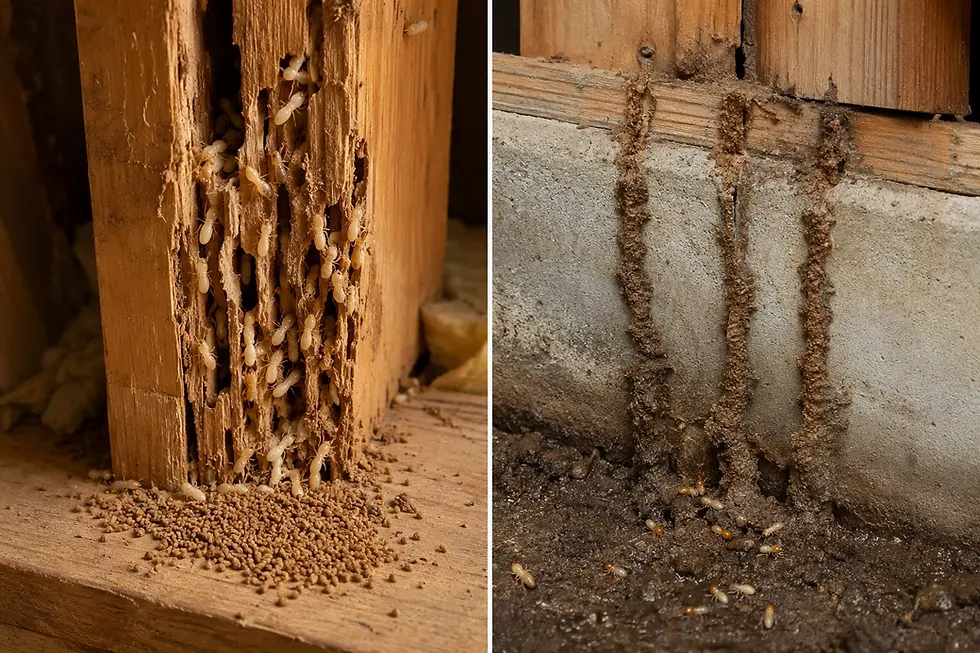
If you've found signs of termites, the most useful first question isn't "how bad is it?" — it's "which kind?" Southern California is home to two very different termites, and telling them apart at home gives you a head start on what comes next, because they live differently, damage your home differently, and require completely different treatments. Here's how to identify what you're dealing with. (For a fuller overview of how termite colonies are structured, see our termites overview.)
The Quick Comparison between Drywood vs. Subterranean Termites
Drywood termites | Subterranean termites | |
Where they nest | Inside the wood itself | In the soil, below ground |
Need soil/moisture? | No | Yes |
Common spots | Attic framing, eaves, window frames, furniture | Foundations, crawlspaces, anywhere near soil |
Colony size | Smaller, slower-growing | Very large, faster damage |
Tell-tale sign | Pellet droppings (frass) | Mud tubes |
Typical treatment | Fumigation or localized treatment | Soil barrier or baiting |
Both are common across the region, and a single property can even host both at once — which is exactly why professional confirmation beats guessing.
How to Spot Drywood Termites
Drywood termites are well suited to Southern California's dry climate because they need no contact with soil or an outside water source — they live entirely inside the dry wood they eat. That lets them turn up in places subterranean termites can't reach: attic and roof framing, fascia and eaves, window and door frames, hardwood floors, and even wooden furniture.
The signs to look for at home:
Frass — small, dry, six-sided pellets that look like sand, sawdust, or coffee grounds, piling up beneath infested wood.
Kick-out holes — tiny round holes in the wood that termites push frass out through.
Discarded wings near windowsills after a swarm.
Because their colonies are small and slow-growing, drywood damage accumulates quietly over years. If this matches what you're seeing, our drywood termite treatment page covers the options.
How to Spot Subterranean Termites
Subterranean termites take the opposite approach: they nest in large underground colonies and depend on soil and moisture, reaching your home by building mud tubes — narrow, pencil-width tunnels of soil and saliva that run up foundations, walls, and piers. Those tubes are the single clearest sign of a subterranean infestation.
Watch for:
Mud tubes on the foundation, exterior walls, piers, or in the crawlspace.
Swarmers and discarded wings, typically in warmer months.
Damaged wood packed with soil, unlike the clean galleries of drywood termites.
Because their colonies can number in the hundreds of thousands, subterranean termites generally cause structural damage faster — which is why they're considered the more destructive of the two.
Our subterranean termite treatment page explains how they're handled.
The Easiest Way to Tell Them Apart at Home
Dry pellets that look like sand or coffee grounds? Frass — a drywood sign.
Pencil-width mud tunnels on the foundation or in the crawlspace? Mud tubes — a subterranean sign.
Look inside damaged wood: drywood galleries are clean and smooth; subterranean galleries are packed with mud and soil.
Swarmers appear for both, but the timing differs in SoCal — subterranean termites tend to swarm in spring, often after rain, while drywood termites usually swarm in late summer and fall, often in the evening near lights.
Why the Difference Completely Changes Treatment
This is the part that matters most. Because drywood termites live in the wood, treatment targets the structure — whole-structure fumigation for widespread infestations, or localized treatments for contained ones. Because subterranean termites live in the soil, treatment targets the ground — liquid termiticide barriers and baiting systems around the foundation. Use the wrong approach for the species and the problem won't be solved, which is exactly why correct identification is the foundation of effective treatment.
What to Do If You Think You Have Termites
Don't disturb the area or reach for a store-bought spray — that can scatter the colony and make professional treatment harder. The right next step is a professional inspection to confirm the species and the full extent. Termike (California Structural Pest Control Board License #PR8832, Branch 2 & 3) has identified and treated both kinds across Los Angeles, Orange, Riverside, and San Bernardino counties for more than 20 years. As an NPMA member, we use FLIR thermal-camera inspection to locate hidden activity inside walls and framing — and qualifying treatments come with a 3-year guarantee, including free re-treatment if termites return.
Frequently Asked Questions about Drywood vs. Subterranean Termites
Can a house have both drywood and subterranean termites?
Yes. They occupy different parts of a home — wood versus soil — so it's entirely possible to have both at once. A professional inspection checks for each.
Which is more destructive?
Subterranean termites generally cause damage faster because their colonies are far larger, but a long-undetected drywood infestation can still do serious cumulative damage. Neither should be ignored.
How can you find termites I can't see?
Much termite activity is hidden inside walls and framing. We use FLIR thermal-camera inspection to detect the temperature differences that reveal hidden activity, so the assessment isn't limited to what's visible on the surface.
Can I treat termites myself?
Store-bought products rarely reach the colony and can make professional treatment harder by scattering the termites. Both species require professional methods matched to the species, so an inspection is the smart first move.
If you've spotted frass or mud tubes, call Termike at (888) 683-3592 or schedule your free inspection, and we'll identify exactly what you're dealing with and recommend the right treatment.


Comments