
Is It Safe to Go Back Inside After Fumigation? The Honest Chemistry

General Safety Information, Not Medical Advice
This article summarizes the chemistry and clearance science behind post-fumigation re-entry. It’s general safety information, not medical advice. Always follow your licensed fumigator’s specific clearance certification and re-entry timing — that certification is the definitive authorization for your specific fumigation. If you or a household member experiences symptoms after re-entry (headache, nausea, eye or throat irritation, dizziness), leave the space and contact Poison Control (1-800-222-1222 in the US) or your physician. Never re-enter a fumigated structure before clearance certification, regardless of how it looks or smells. |
The tent came off. The fumigator says the house is cleared. Your family is standing in the driveway with two days of stuff crammed into the car, and everyone’s ready to walk back in — except now you’re standing there thinking about it. Is it actually safe in there? What if there’s residue on the counters? What about the food we forgot to bag in the pantry? What if we open a cabinet that was sealed and get a lungful of whatever was in there? These are all completely reasonable questions, and the underlying is it safe to go back inside after fumigation concern deserves a real answer, and the honest answer is more precise than either ‘totally fine, just walk in’ or ‘be terrified, don’t touch anything.’
Here’s the honest reality about the is it safe to go back inside after fumigation question, and it comes down to actual chemistry. Sulfuryl fluoride — the active gas in Vikane, the fumigant used in the vast majority of California termite tenting — off-gasses completely once the tent comes off and the structure ventilates. It doesn’t leave residue on surfaces, food, or fabrics the way older fumigants sometimes did. This part isn’t marketing spin — it’s established chemistry that clearance testing verifies before you’re allowed back in.
But two specific concerns are legitimate and worth understanding. First, the chloropicrin warning agent added to make the gas noticeable is more persistent than sulfuryl fluoride itself and can linger in enclosed spaces. Second, enclosed containers, cabinets, sockets, and other sealed spaces can trap gas that hasn’t fully dispersed. The California Department of Public Health has documented post-clearance illness cases specifically tied to these two issues — meaning re-entry is safe when done properly, but the ‘done properly’ part matters.
Let’s walk through what sulfuryl fluoride actually does chemically, how clearance testing works and what it confirms, why chloropicrin residue is the underappreciated concern, and the specific re-entry protocols that keep your household safe once the fumigator hands you the keys.
Quick Answer
Is it safe to go back inside after fumigation? Yes, once the fumigator’s certified clearance testing confirms safe re-entry — never before.
Does Vikane leave residue on surfaces or food? No. Sulfuryl fluoride off-gasses completely and doesn’t leave surface residue.
What about the tear-gas smell after re-entry? That’s chloropicrin — a warning agent added deliberately. It fades with ventilation but is the reason for eye/throat irritation.
Are enclosed spaces still a concern after clearance? Yes — cabinets, closets, drawers, sockets, and air mattresses can trap gas. Open and ventilate them thoroughly on re-entry.
First move? Follow your fumigator’s exact re-entry protocol. Questions? Call Termike at (888) 683-3592. |
Why You Can Trust Termike Pest Control
License: California Structural Pest Control Board — License PR8832 (Branch 2 & 3 certified)
Membership: National Pest Management Association (NPMA)
Experience: 25+ years serving Orange County, LA County, Riverside & San Bernardino County
Certified Clearance Testing: Fumigations we coordinate are cleared by licensed fumigators using proper gas-detection equipment — no shortcuts on the safety-critical step
Straight Answers on Residue Chemistry: We’ll tell you honestly what stays behind, what doesn’t, and what the CDPH research actually shows — not marketing bullet points |
What Actually Happens Chemically During and After Fumigation
Answering is it safe to go back inside after fumigation starts with knowing what got pumped into the house in the first place, and what happens to it during the aeration process.
Sulfuryl Fluoride — The Main Fumigant
Vikane’s active ingredient is sulfuryl fluoride — a colorless, odorless gas that penetrates all wood in the structure and kills termites (Drywoods especially) plus a range of other wood-destroying organisms. The key chemistry from a safety perspective is that sulfuryl fluoride is a small, volatile gas molecule. When the tent comes off and the structure ventilates, it dissipates into the atmosphere without binding to surfaces, food, dishes, or fabrics. This is fundamentally different from older fumigants (like methyl bromide) that sometimes left detectable residues.
Chloropicrin — The Warning Agent
Because sulfuryl fluoride is odorless and colorless, fumigators add a small amount of chloropicrin — chemically similar to tear gas — as a warning agent. If any leak happens or if someone enters the treatment zone during fumigation, the chloropicrin creates immediate eye and throat irritation as a safety signal. The catch is that chloropicrin is chemically more persistent than sulfuryl fluoride. It off-gasses more slowly and can linger in enclosed spaces even after sulfuryl fluoride has fully dissipated. This is the residual concern that gets underappreciated in casual descriptions of fumigation safety.
Aeration — The Clearance Phase
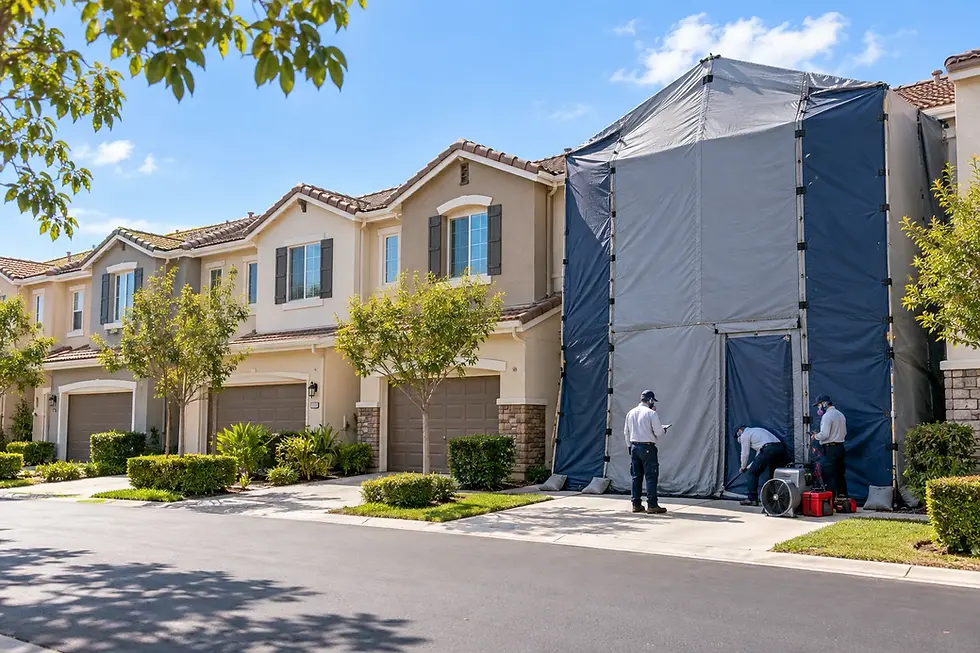
After the treatment period ends, the tent is removed and the structure is aerated — typically for at least 6 hours, often longer. Fans, open windows, and structural airflow drive the gases out. During this phase, the fumigator uses gas-detection equipment to test residual concentrations in multiple rooms. Only when readings drop below the EPA re-entry threshold (currently 1 part per million for sulfuryl fluoride) is clearance certified. Termike’s guide on moving back in after termite fumigation covers the logistics side of this transition.
According to the California Department of Pesticide Regulation, licensed fumigators are required to conduct proper aeration and clearance testing before authorizing re-entry — which is the regulatory backbone that makes fumigation safe when applied correctly.
How Clearance Testing Actually Confirms It Is Safe to Go Back Inside After Fumigation
The clearance certification isn’t just a signature on a piece of paper — it’s the result of active gas-concentration measurements taken across the structure. Understanding what clearance does and doesn’t confirm helps homeowners re-enter with realistic expectations.
What Clearance Testing Measures
• Sulfuryl fluoride concentration at multiple locations. Fumigators test living areas, bedrooms, and often confined spaces to confirm gas has dispersed below the 1 ppm re-entry threshold
• Structural readings. Multiple points across the structure — meaning a house that clears in the living room but has a trapped pocket in a back closet should not receive certification
• Chloropicrin as a secondary signal. If chloropicrin irritation is still detectable, that’s a sign aeration isn’t complete and further ventilation is warranted
What Clearance Does Not Directly Confirm
• Enclosed-container concentrations. Cabinets kept closed, sealed drawers, sockets, and other confined spaces may hold trapped gas that clearance measurements didn’t sample. This is exactly why open-and-ventilate protocols on re-entry matter
• Individual sensitivity. Clearance thresholds are general safety limits, not personalized thresholds for pregnancy, infants, immunocompromised people, or those with pre-existing respiratory conditions. Extended re-entry timelines are reasonable for these situations
• Chloropicrin fully dispersed. Chloropicrin’s persistence in enclosed materials (fabrics, upholstery, some porous surfaces) can cause lingering irritation even when sulfuryl fluoride has fully cleared. This is fixable with continued ventilation but is a real post-clearance experience
The Chloropicrin Residue Concern Homeowners Rarely Hear About
This is the piece that gets underappreciated when homeowners ask is it safe to go back inside after fumigation. California Department of Public Health investigations into post-fumigation illness cases have consistently pointed to the same pattern — most reported illness happens AFTER clearance, not during fumigation itself. And the specific mechanism is often chloropicrin lingering in enclosed spaces the homeowner didn’t know to open.
• Cabinets that stayed closed. Kitchen and bathroom cabinets, dresser drawers, closet spaces sealed during treatment. Gas seeps in during fumigation and doesn’t fully leave during aeration
• Electrical sockets and switches. Small enclosed volumes but the gas gets there. On re-entry, these off-gas slowly
• Air mattresses, cushions, and sealed foam. Porous materials trap gas that releases over hours or days
• Refrigerators and appliances. The fridge itself is typically fine (properly emptied and closed), but freezers with unopened food packaging can hold residue in the packaging
• Poorly-ventilated rooms. Rooms without cross-ventilation take longer to fully clear. Attics and closets are common examples
According to California Department of Public Health occupational-health documentation, awareness of these post-clearance sources is exactly why proper re-entry protocols include opening every cabinet, drawer, and closet and ventilating for a period after re-entering. This isn’t alarmist — it’s what the science actually shows.
Re-Entry Protocol — What Actually Keeps You Safe
The practical steps that turn a properly-cleared fumigation into a safe re-entry.
1. Never enter before certified clearance. Regardless of how the house looks or smells, official clearance documentation is the authorization. Don’t take shortcuts on this
2. Open windows on the way in. Front door, back door, windows on both sides of the house — cross-ventilation for at least the first hour
3. Open every cabinet, drawer, and closet. Kitchen cabinets, bathroom vanities, bedroom closets, garage cabinets, laundry storage — everything closed during fumigation gets opened and left open for at least 30 minutes
4. Air out upholstery and mattresses. Flip cushions, pull back sheets, and let porous materials off-gas. Air mattresses particularly hold residue
5. Run fans. Ceiling fans, box fans in windows, HVAC on ‘fan’ mode to circulate air. Aeration doesn’t stop when the fumigator leaves
6. Watch for symptoms and act on them. Headache, nausea, eye or throat irritation, dizziness after re-entry — leave the space, ventilate more, and contact your fumigator and physician if symptoms persist. Poison Control (1-800-222-1222) is the right first call for any acute symptoms
7. Give sensitive household members extra buffer. Pregnant people, infants, immunocompromised, and those with respiratory conditions can benefit from an extra day of ventilation before returning even after certified clearance
The U.S. Environmental Protection Agency identification and treatment framework emphasizes that fumigation is used safely millions of times — with proper aeration, certified clearance, and post-clearance protocols making the difference between safe and problematic re-entry.
The Bottom Line
The is it safe to go back inside after fumigation question has a real, honest answer — yes, when clearance is properly certified and re-entry protocols are actually followed. Sulfuryl fluoride, the active gas in Vikane, off-gasses completely during aeration and doesn’t leave surface residue on counters, food, or dishes. The two legitimate concerns are chloropicrin — the warning agent added to make gas leaks noticeable, which is more persistent than sulfuryl fluoride — and trapped gas in enclosed spaces like cabinets, sockets, and porous materials. California Department of Public Health investigations show most post-fumigation illness happens after clearance, tied to these specific mechanisms. The fix is straightforward and non-negotiable: never re-enter before certified clearance, open every cabinet and closet on re-entry, ventilate aggressively for at least an hour, watch for symptoms, and give sensitive household members extra buffer time. Fumigation is used safely in millions of California homes every year — but ‘safe when applied correctly’ only holds when the aeration and re-entry protocols get followed correctly.
Frequently Asked Questions
Is it safe to go back inside after fumigation without opening cabinets and closets first?
Not entirely — and this is exactly where the California Department of Public Health has documented most post-clearance illness cases. Sulfuryl fluoride, the active gas in Vikane, off-gasses completely from open spaces during aeration. But cabinets, drawers, closets, and other enclosed spaces that stayed closed during fumigation can trap chloropicrin (the warning agent added to make gas noticeable) which is more persistent than sulfuryl fluoride. Opening every cabinet, drawer, and closet on re-entry and ventilating for at least 30 minutes is the practical step that addresses this trapped-gas concern. Never skip it — even when certified clearance has confirmed the general structure is safe.
Will Vikane fumigation leave residue on my food, dishes, or counters?
No, when applied correctly. Sulfuryl fluoride is a small volatile gas molecule that off-gasses completely during proper aeration and doesn't bind to surfaces, food packaging, or fabrics the way some older fumigants (like methyl bromide) sometimes did. This is a fundamental chemistry difference, not marketing. That said, food that was left unsealed during fumigation was directly exposed to the gas mixture during treatment and should not be consumed — the standard advice to bag all consumables in fumigation-approved bags exists specifically because unbagged food takes up gas during treatment even though sulfuryl fluoride doesn't leave permanent residue on surfaces afterward. Dishes, sealed food containers, and clean surfaces don't require special cleaning after clearance.
How long should I wait before letting kids, pets, or pregnant family members re-enter?
The fumigator's certified clearance is the minimum standard for anyone re-entering — never before that. But for pregnant people, infants, immunocompromised household members, and those with pre-existing respiratory conditions, extended re-entry timing is reasonable. Many households have these members stay elsewhere for an additional day or two after certified clearance, allowing extra ventilation time to fully clear chloropicrin residue from enclosed spaces and porous materials. This isn't a regulatory requirement — it's a practical precaution that reflects individual sensitivity variations that general clearance thresholds don't personalize for. Discuss with your fumigator and, for specific concerns, your physician.
What if I feel sick after re-entering the house post-fumigation?
Take symptoms seriously. Headache, nausea, eye or throat irritation, dizziness, or respiratory discomfort after re-entry warrant leaving the space immediately, opening more windows and doors, and letting the structure ventilate further. Contact your fumigator to report the symptoms and to coordinate additional aeration if needed. For acute symptoms, contact Poison Control (1-800-222-1222 in the US) — they can advise on whether medical evaluation is warranted based on your specific exposure. If symptoms persist after leaving the space, seek medical care. Symptoms after clearance are uncommon when protocols are followed but do happen, most often from trapped gas in cabinets or closets that weren't opened on re-entry. The response is straightforward — leave, ventilate, call for guidance.
Fumigation Coming Up? Free Pre-Fumigation Consultation
Whether it’s the treatment itself or the re-entry period you’re worried about, straight answers help. Termike’s free consultation walks through what happens chemically, what clearance actually confirms, and what protocols protect your household on re-entry. Call: (888) 683-3592 Or book online → Schedule Your Free Inspection |


Comments