
Termites in a Wood Deck: How to Spot the Damage Before a Board Gives Way
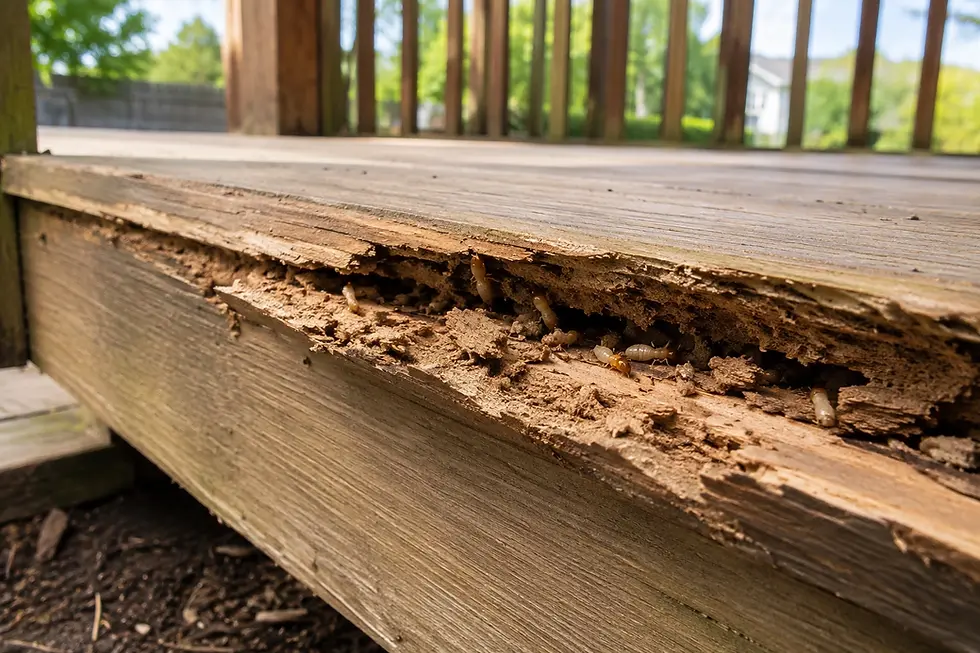
Your deck gets more scrutiny than almost anything else you own — you walk it barefoot, drag furniture across it, sweep it, and stare at it all summer. And yet the parts that actually hold it up are the parts nobody ever looks at: the bottoms of the posts where they meet the soil, the underside of the joists, and the board bolted to your house that carries most of the load.
That blind spot is the whole problem. Termites in a deck almost always start in exactly those hidden, ground-contact areas — and by the time a surface board feels spongy, the structure underneath has usually been compromised for a while. A deck is also the one wooden structure people routinely stand on in groups, which makes this more than a repair-cost question.
Here's why decks get targeted, the specific spots worth checking, the simple probe test that tells you more than looking ever will, and why a deck colony rarely stays in the deck.
Quick Answer: What to Know About Deck Termites Why do decks get termites? Deck posts sit in or on soil, giving subterranean termites direct access, and outdoor wood stays damper than indoor framing — moisture is what they need. Isn't pressure-treated wood termite-proof? No. It resists termites and decay, but it isn't immune — cut ends, weathering, and older treatments all reduce protection. Where should I check first? Post bases at ground level, the ledger board where the deck attaches to the house, joists, and stair stringers. What's the best DIY test? The screwdriver probe test — press a screwdriver into the wood at post bases; if it sinks in easily, the wood is compromised. Can deck termites get into my house? Yes. The ledger board bolts the deck directly to your home's framing, which is a ready-made bridge. Call Termike at (888) 683-3592. |
Why You Can Trust Termike Pest Control License: California Structural Pest Control Board — License PR8832 (Branch 2 & 3 certified) Membership: National Pest Management Association (NPMA) Experience: 20+ years serving Orange County, LA County, Riverside & San Bernardino County Deck-to-Structure Assessment: We inspect the deck AND the ledger connection to your home — because a deck colony rarely stays in the deck Treatment + Repair: Licensed for soil and bait treatment as well as structural wood repair, so one team handles both halves |
Why Decks Are Such an Easy Target
A deck sits at the exact intersection of everything subterranean termites need, which is why termites in a deck are so much more common than termites in, say, a second-floor bedroom wall.
Ground Contact
Deck posts either sit in the soil or rest on footings just above it, and stairs usually land directly on grade. That wood-to-soil proximity is the single biggest risk factor for subterranean termites, which live in the ground and need a path to wood. The UC Integrated Pest Management Program identifies wood in contact with soil as a primary conducive condition for subterranean infestation. Termike's guide on subterranean termites explains how these colonies operate.
Constant Moisture
Decks catch rain, hold irrigation overspray, and stay damp underneath where sun never reaches. Shaded soil beneath a low deck can stay moist year-round — ideal conditions for a colony. Add planters, stored items, or a woodpile tucked under there, and you've built a termite-friendly microclimate against your house.
Nobody Inspects the Underside
The structural half of a deck lives out of sight. Joists, beams, post bases, and the ledger connection get looked at almost never — which means a colony can work through them for years while the surface decking still looks perfectly fine.
"But It's Pressure-Treated" — The Myth Worth Correcting
This is the most common reason people dismiss the possibility of termites in a deck, so it's worth being precise: pressure-treated lumber is termite-resistant, not termite-proof. The distinction matters.
• Cut ends are exposed. Every time a board is cut to length during construction, the untreated interior is exposed unless the installer sealed it — and most don't
• Treatment depth varies. Preservative penetrates the outer layer far better than the core, so deep checks and splits can expose vulnerable wood
• Weathering wears it down. Decades of sun, rain, and thermal cycling degrade the protection, and older decks were treated with different formulations than current lumber
• Termites can bridge over it. Even where the wood itself resists them, subterranean termites can build mud tubes across a treated post to reach untreated wood above
So a pressure-treated deck is genuinely better protected than an untreated one — but "better protected" is not the same as "don't bother checking."
Where to Check: The 5 Spots That Matter
If you're inspecting for termites in a deck, these five locations account for the overwhelming majority of what gets found. Work through them in order.
1. Post bases at ground level. The number-one spot. Check where each post meets soil or its footing, all the way around. Look for mud tubes running up the post, soft or crumbling wood, and dirt packed into cracks
2. The ledger board. This is the board bolted to your house that the deck hangs from — structurally the most important piece and the most consequential place to find damage. Check where it meets the siding, and look for staining, soft wood, or tubes
3. Joists and beams underneath. Get a flashlight and look at the underside where you can safely reach. Scan along the length of joists for mud tubes, blistering, and hollow-sounding sections
4. Stair stringers. Stairs land on soil, which puts the stringer bottoms in the highest-risk position on the whole structure. Check the base of each stringer carefully
5. Railings and above-grade wood. Drywood termites can colonize railings, posts caps, and above-ground members from the air — look for tiny kick-out holes and pellet piles here rather than mud tubes
The Probe Test: Better Than Looking
Visual inspection has a real limitation on decks, because termites hollow wood from the inside while leaving a thin outer shell. A post can look completely sound and be structurally empty. That's why the probe test is the single most useful thing you can do:
6. Take a flathead screwdriver or an awl. Nothing specialized needed
7. Press firmly into the wood at post bases, stringer bottoms, and the ledger board. Use steady pressure, not a stab
8. Read the result. Sound wood resists and the tip barely enters. Compromised wood lets the tool sink in easily, feels spongy, or crumbles away
9. Note anything that gives way. Photograph it and mark the location — an inspector will want to know exactly where
One caution worth stating plainly: if a post base or ledger board is soft enough that a screwdriver sinks in, treat the deck as potentially unsafe and keep weight off it until it's properly assessed. Decks fail under load, and load means people.
Also check for the tell-tale evidence itself — pencil-width mud tubes on posts or piers point to subterranean activity, and Termike's guide on what to do when you find mud tubes on your foundation applies equally to deck posts. Small piles of six-sided pellets point instead to drywood, covered in Termike's signs of drywood termites guide.
Why a Deck Colony Rarely Stays in the Deck
Here's the part that turns this from a deck-repair issue into a house issue. Your deck isn't a separate structure — it's bolted to your home through the ledger board, which fastens directly into the rim joist of the house framing.
That connection is a continuous wood pathway. A subterranean colony that establishes at a deck post can forage along joists to the ledger, and from the ledger into the framing of your house. It's one of the most direct routes indoors that exists on a typical property, and it bypasses the foundation entirely.
This is exactly why a deck finding warrants inspecting the house too, not just the deck. It also connects to the broader yard picture — if a colony is active at your deck posts, it's established in the surrounding soil, which Termike's guide on subterranean termites in the yard addresses. And storing firewood beneath or beside a deck compounds the risk considerably — a topic worth its own attention.
Prevention: Making Your Deck Less Inviting
• Break wood-to-soil contact. Use metal post bases or concrete footings that hold posts above grade wherever possible
• Fix the drainage. Grade soil away from posts, redirect downspouts, and adjust sprinklers that soak the deck area
• Clear out underneath. Remove stored lumber, firewood, cardboard, and debris from under the deck — each is both food and shelter
• Keep it ventilated and trimmed. Cut back vegetation crowding the deck so air and sun reach the soil beneath
• Seal cut ends and re-finish. Maintaining the finish and sealing exposed cuts preserves what protection treated lumber offers
• Inspect annually. A five-minute probe check each year catches problems while they're still cheap
If a check does turn up activity, treatment comes before repair — replacing boards over a live colony means paying twice. Termike is licensed for both soil and bait treatment and for the damaged wood repair that follows, and the termite damage cost versus treatment comparison shows why early action is so much cheaper.
The Bottom Line
Termites in a deck hide in the five places you never look — post bases, ledger board, joists, stringers, and railings — and pressure-treated lumber slows them without stopping them. Take a screwdriver to the post bases once a year, keep wood out of the soil and clutter out from underneath, and remember that the ledger board connects everything you find straight to your house. Ten minutes with a flashlight beats discovering the problem when a board gives way underfoot.
Frequently Asked Questions About Termites In a Deck
Q: Can termites really get into a pressure-treated deck?
A: Yes. Pressure-treated lumber is termite-resistant, not termite-proof. Cut ends made during construction expose untreated interior wood unless sealed, preservative penetrates the outer layer better than the core, and decades of weathering degrade the protection — especially on older decks treated with earlier formulations. Subterranean termites can also build mud tubes across a treated post to reach untreated wood above it.
Q: Where do termites in a deck usually start?
A: At the points closest to soil. Post bases where they meet the ground or footings are the number-one location, followed by stair stringers, which land directly on grade. From there termites move along joists and beams toward the ledger board. Railings and above-grade members are a different risk — drywood termites can colonize those from the air, leaving pellet piles and tiny kick-out holes rather than mud tubes.
Q: How do I test my deck for termite damage myself?
A: Use the screwdriver probe test. Press a flathead screwdriver or awl firmly into the wood at post bases, stringer bottoms, and the ledger board using steady pressure. Sound wood resists and the tip barely enters; compromised wood lets it sink in easily, feels spongy, or crumbles. Photograph anything that gives way. Important: if a post base or ledger board is that soft, keep weight off the deck until it is professionally assessed.
Q: Can termites move from my deck into my house?
A: Yes, and it is one of the more direct routes that exists. The ledger board bolts the deck into your home's rim joist, creating a continuous wood pathway that bypasses the foundation entirely. A subterranean colony established at a deck post can forage along the joists to the ledger and into the house framing. That is why a deck finding warrants inspecting the house as well. Termike assesses both — call (888) 683-3592.
Deck Feeling Soft? Get It Checked Before It Reaches the House A deck sits on soil and attaches to your home — which makes it both the easiest place for a colony to start and the shortest path indoors. Termike inspects the deck, the post bases, and the ledger connection, then treats and repairs what needs it. Call: (888) 683-3592 Or book online → Schedule Your Free Inspection |


Comments