
Termite Damaged Wood Repair or Replace and How to Decide
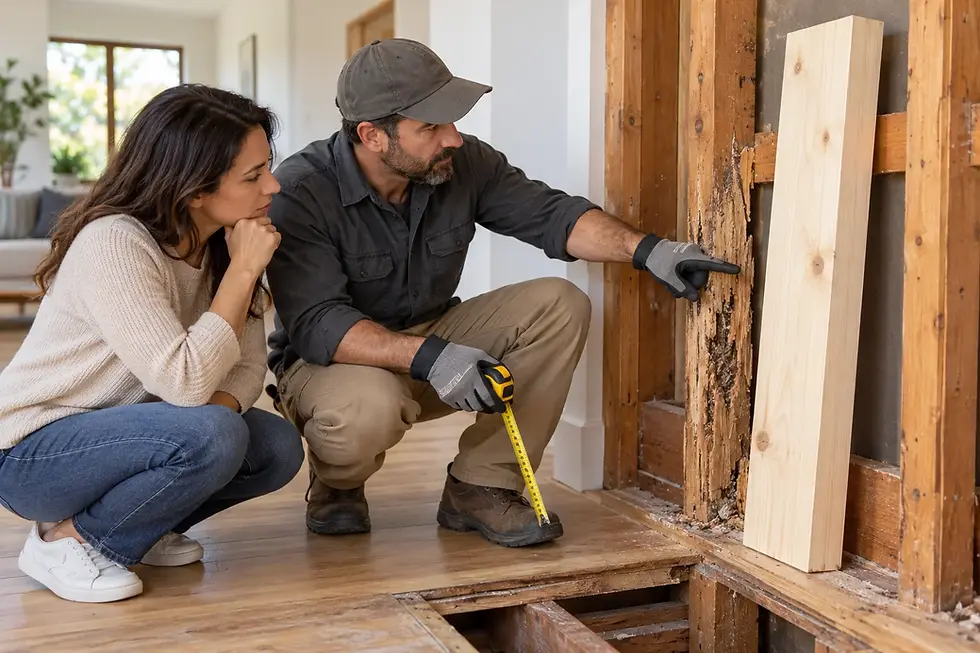
The termites are handled, the treatment is done, and now you’re standing in front of the damage they left behind — a soft, papery section of door frame, a joist in the crawl space that sounds hollow when you knock it, a stretch of baseboard that crumbles at the edge. The obvious question is also the expensive one: can you just patch and fill this, or does it all have to come out and be rebuilt? One path is a weekend and a tube of filler; the other is a contractor and a permit.
It’s the question every homeowner faces after an infestation, and the answer is more decidable than it looks. The whole termite damaged wood repair or replace decision really comes down to two things — the wood’s structural role and how much of it is actually gone. Get those two straight and the right call becomes obvious. Let’s walk through what can be repaired, what has to be replaced, the one step you must do first, and who handles each part.
Quick Answer
What decides repair vs replace? The wood’s structural role and the extent of the damage — cosmetic and non-load-bearing can often be repaired; load-bearing or hollowed must be replaced.
What can be repaired? Surface or minor damage to non-structural wood, using wood hardeners, fillers, or sistering a new piece alongside.
What has to be replaced? Load-bearing members — beams, joists, sill plates, studs — that are hollowed out or significantly compromised.
What do I do first? Always eliminate the termites before repairing, or you rebuild over an active colony.
Who does the work? Pest control treats; a qualified contractor handles structural repairs. Call Termike at (888) 683-3592. |
Why You Can Trust Termike Pest Control
License: California Structural Pest Control Board — License PR8832 (Branch 2 & 3 certified)
Membership: National Pest Management Association (NPMA)
Experience: 25+ years serving Orange County, LA County, Riverside & San Bernardino County
Treat-First Discipline: We eliminate the termites before any wood is repaired, so you never rebuild over an active colony
Honest Scope: We tell you plainly which wood is cosmetic and repairable versus structural and in need of replacement — no overselling |
Termite Damaged Wood Repair or Replace — the Deciding Factors
Before you touch a board, get clear on the two questions that drive everything. The entire termite damaged wood repair or replace call hinges on them, and they’re simpler than the anxiety around the decision suggests.
• Is the wood structural or cosmetic? Does this piece carry load and hold the house up (a beam, joist, stud, or sill plate), or is it finish and trim (baseboard, casing, some siding)? Structural wood has a much lower tolerance for damage
• How much of the wood is actually gone? Is the damage a shallow surface channel, or is the piece hollowed out and soft through its cross-section? Surface damage is survivable; a hollow core is not
• Is there moisture or rot too? Termites and water damage often travel together, and dry rot changes the plan. Termike’s guide on termite damage versus water damage and its dry rot repair guidance cover that overlap
• How much is there, overall? A single damaged board is a different project from widespread damage across a framed wall. Termike’s guide on how much termite damage is too much helps you gauge it
Termite Damaged Wood Repair or Replace for Structural Members
Structural wood is where people most want a shortcut and least should take one. For load-bearing members, the termite damaged wood repair or replace answer leans hard toward replace whenever the damage is more than superficial, because these pieces are literally holding your home up. A hollowed joist, a studs riddled through its core, or a sill plate that’s lost its integrity can’t be safely “filled” — it needs to be replaced, or in some cases reinforced by sistering a sound new member alongside it where a structural pro determines that’s adequate. This is also where permits and a qualified contractor come in, since structural work is inspected for a reason. By contrast, non-structural finish wood with only surface damage is the classic repair candidate. Termike’s guides on who repairs termite damage and its complete wood-repair restoration guide lay out how those repairs are actually done.
According to the University of California Integrated Pest Management Program, termites hollow wood from the inside out, so a member can look intact on the surface while being structurally compromised within — which is exactly why assessing the true cross-section, not just the visible face, decides whether it can be repaired.
What Can Usually Be Repaired
Plenty of termite damage doesn’t require demolition. When the wood is non-structural and the damage is limited to the surface, these approaches restore it well.
• Wood hardeners and consolidants. Liquid products soak into and re-harden softened, partially damaged wood, stabilizing it
• Wood fillers and epoxy. Structural epoxy fillers rebuild missing sections of non-load-bearing wood and can be sanded and painted
• Patching small areas. Limited damage to trim, casing, and similar finish wood can be cut out and patched
• Sistering (in the right cases). Adding a sound new board alongside a partially damaged one can reinforce it when a pro judges the original still has enough integrity to keep
What Has to Be Replaced and Why Order Matters
Some damage simply can’t be patched, and trying is unsafe. Replacement is the right call when the wood is compromised beyond repair or structural.
• Hollowed or extensively damaged wood. If a piece is eaten through its core, fillers can’t restore its strength — it comes out
• Load-bearing members with real damage. Beams, joists, studs, and sill plates that have lost integrity are replaced (or properly reinforced), not filled
• Anything structurally unsound. If a member can’t safely carry its load, no cosmetic fix changes that
The one rule that comes before any repair or replacement, every time: eliminate the termites first. Rebuilding or filling wood while a colony is still active just feeds the new material to the same termites. Treatment comes before restoration, full stop. Termike’s guide on the termite structural damage timeline shows why acting promptly in the right order matters.
The U.S. Environmental Protection Agency emphasizes eliminating the infestation as the foundation of termite control, which is why treatment precedes any structural repair rather than running alongside it.
Who Does What and What It Costs
The repair-or-replace project usually involves two different professionals, and knowing who does what keeps it organized.
1. Pest control eliminates the termites. This happens first and is a separate scope from the carpentry
2. A qualified contractor handles structural repair or replacement. Replacing joists, studs, or beams is skilled, often permitted work
3. Minor cosmetic repair can be simpler. Non-structural filling and patching is sometimes within a handy homeowner’s reach, though reaching hidden or high areas may still warrant a pro
4. Expect the repair to be itemized. Treatment and repair are separate line items, and the repair cost scales with how much is structural. Termike’s guide on why a termite damage estimate can seem so high explains that breakdown
5. Confirm the scope with an inspection. A professional assessment tells you what’s truly structural before anyone quotes repair or replacement
The Bottom Line
Facing a stretch of chewed-up wood after an infestation feels daunting, but the termite damaged wood repair or replace decision resolves to two clear questions: what is the wood’s structural role, and how much of it is actually gone. Non-structural finish wood — baseboards, casing, trim — with only surface damage is usually repairable with wood hardeners, epoxy fillers, patching, or sistering a sound board alongside. Load-bearing members like beams, joists, studs, and sill plates that are hollowed out or significantly compromised need to be replaced or properly reinforced, because fillers can’t restore strength to wood that’s been eaten through its core, and these pieces are holding your home up. Remember that termites hollow wood from the inside out, so a board can look fine on its face while being unsound within, which is why the true cross-section decides the call and why a professional assessment matters. And one rule overrides everything else: eliminate the termites before you repair or replace a single board, or you’ll simply rebuild into an active infestation. Treat first, then let pest control and a qualified contractor handle their separate parts, base the repair-or-replace choice on structure and extent rather than guesswork, and you’ll restore the home soundly instead of papering over a problem that’s still eating.
Frequently Asked Questions
How do I know whether termite-damaged wood can be repaired or needs replacing?
It comes down to two questions: the wood's structural role and the extent of the damage. First, ask whether the piece is structural (a beam, joist, stud, or sill plate that carries load and holds the house up) or cosmetic (baseboard, casing, trim, some siding). Structural wood has a much lower tolerance for damage. Second, ask how much of the wood is actually gone — a shallow surface channel is very different from a piece that's hollowed out and soft through its whole cross-section. Non-structural finish wood with only surface damage is usually repairable with hardeners, fillers, or patching. Load-bearing wood that's hollowed or significantly compromised generally needs replacement or professional reinforcement. A crucial catch is that termites eat wood from the inside out, so a member can look solid on its visible face while being unsound within. That's why you can't judge purely by appearance — the true internal condition of the wood, best confirmed by a professional assessment, is what actually decides repair versus replacement.
Can structural beams or joists just be filled instead of replaced?
Generally no, if the damage is more than superficial. Wood fillers, epoxy, and hardeners are excellent for non-structural, cosmetic wood with surface-level damage, but they do not restore load-bearing strength to a beam or joist that's been hollowed out or eaten through its core. These members are literally holding your home up, so a cosmetic fix that merely looks solid can be dangerous. When a load-bearing member is compromised, the correct options are to replace it or, in some cases, to reinforce it by 'sistering' — attaching a sound new member alongside the original — but only when a qualified structural professional determines the original retains enough integrity for that to be adequate. This kind of work is typically permitted and inspected precisely because getting it wrong has safety consequences. So while it's tempting to reach for a filler on a damaged joist to save money and effort, structural members are exactly where you shouldn't cut corners. Have the piece assessed by a pro, and let the decision rest on its actual remaining strength rather than how it looks once patched.
Do I need to treat the termites before repairing the wood?
Yes — always, without exception, and this is the single most important rule in the whole process. Repairing or replacing wood while a termite colony is still active simply hands the fresh new material to the same termites, so you'd be paying to rebuild a meal. Treatment must come first: eliminate the infestation with the appropriate method (soil barriers or bait for subterranean termites, fumigation or localized treatment for drywood), and only then move on to restoration. Skipping this order is one of the most costly mistakes homeowners make, because the repair can look perfect while the underlying problem quietly continues. It also matters for sequencing your professionals: pest control handles the elimination as one scope, and a contractor handles the carpentry as a separate scope afterward. If you're coordinating both, make sure the treatment is genuinely complete and verified before the repair work begins. Treating first protects the money and effort you're about to put into the repair, and it's the only way to be confident the restored wood will stay sound.
Who should I hire to repair termite-damaged wood, and is it a DIY job?
It depends on whether the damage is cosmetic or structural, and the project usually involves two different professionals. Pest control eliminates the termites first — that's a distinct scope from any carpentry. For the repair itself, minor, non-structural cosmetic work (filling or patching limited damage to trim, casing, or similar finish wood) is sometimes within reach of a capable homeowner, though reaching hidden, high, or crawl-space areas safely can still justify hiring help. Structural repair or replacement — swapping out joists, studs, beams, or sill plates — is skilled, often permitted work that should go to a qualified contractor, because it affects how the home carries load and is inspected for safety. Expect the costs to be itemized separately from the treatment, with the repair portion scaling up as more of the damage turns out to be structural. The smartest first move is a professional inspection that defines exactly what's cosmetic versus structural, so you know which parts you might handle yourself and which genuinely need a contractor before anyone quotes the work. Termike can assess the full scope with a free inspection — call (888) 683-3592.
Not Sure What Has to Come Out? Get a Free FLIR Inspection Before you fill a board or tear one out, you need to know what’s cosmetic and what’s structural. Termike’s free FLIR inspection maps the true extent of the damage and the hidden parts behind it, so repair-or-replace decisions are based on facts. Call: (888) 683-3592 Or book online → Schedule Your Free Inspection |


Comments